

The Bolsheviks Needed More than Snowballs
- Peter Gaughan

- Jan 23, 2021
- 4 min read
Updated: Feb 20, 2022
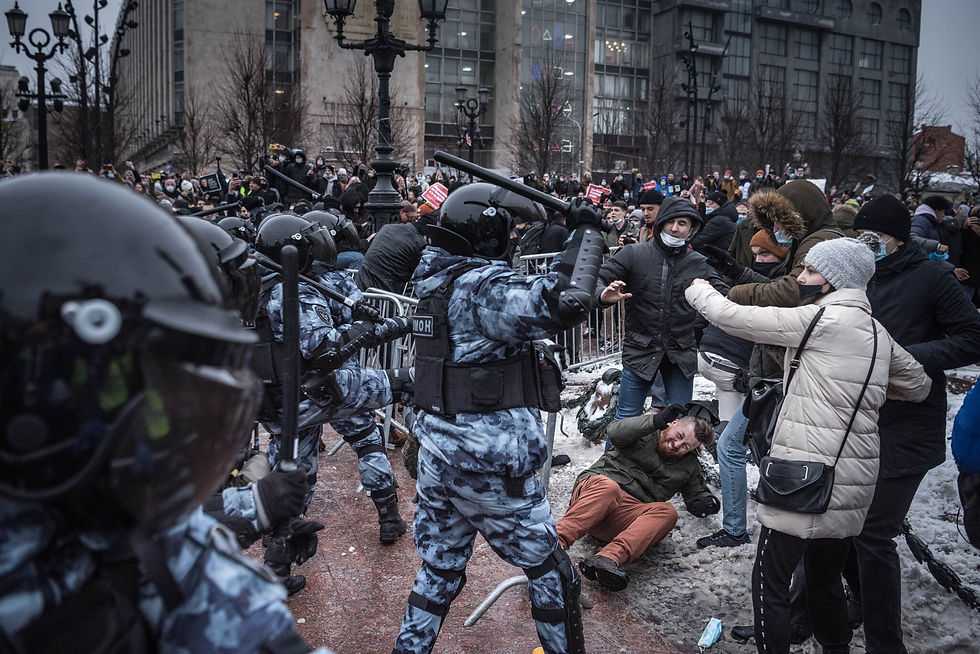
Russians have once again taken to the streets in protest of the Kremlin's corruption and its suppression of critics.
I suggest checking out the linked article below by the New York Times for details on the series of events the caused people across the nation to bare the cold (at times protesting in -60 degree Fahrenheit temperatures) and risk merciless brutalization by Russian law enforcement.
But the TL;DR is there is a Russian opposition leader named Aleksei Navalny who has been one of Russia's most outspoken critics. In August of 2020, he was poisoned using a lethal nerve agent by the Russian government, seemingly an attempt to stop his constant investigations into the Kremlin's corruption. While polling indicates Navalny poses little electoral threat to Putin and his United Russia political party, which has a strangle hold on the State Duma (the Russian Parliament), he remains one of the most recognized, respected, and successful opponents to single-party rule in Russia. He survived the attempt on his life, recovered in Germany, and then returned to Russia this week to be immediately arrested at a passport check. The Russian Government had warned Navalny that upon his return he would face arrest for violating his parole terms following at 2014 embezzlement conviction (a trial the European Court of Human Rights determined to be unfair).
In response to Navalny's arrest, as the nation of Russia woke up across its eleven time zones so did the protests. Starting in the furthest eastern parts of the country (including Siberia), people took to the streets to protest the arrest and to admonish a system of blatant corruption.
More than 3,000 protestors gathered in over a hundred cities to chant things like "Putin is a thief". This type of national mobilization might appear to an outsider like a watershed moment for Russia. Though if that outsider happens to be American, I would remind them that at least 13 unarmed Black people have been killed since the murder of George Floyd, including at least 2 in 2021, after what might've appeared to be a watershed moment for the United States.
In fact, we have seen this in Russia before. Most recently, Navalny himself was a key organizer of protests from March 2017 to October 2018 in response to the government refusing his bid to run for office, corruption, a plan by Russia to raise the retirement age, police brutality, and Putin/United Russia's authoritarianism.
So forgive me if I am less than optimistic about the future of Russia and the effectiveness of these demonstrations. I do think it is excellent that opposition exists domestically and that Russian civil society is organized enough to facilitate over a hundred demonstrations across its massive landmass. Protest is pillar of liberalization (in the Kantian "yay-democracy" way not the "my ass is better than your trunk" way). But, these protestors are throwing literal snowballs at military grade government operatives.
Russia (and over half of Russians) seem to have no motivation to change. The nation went from Czars and feudalism to revolutionary chaos to soviet authoritarianism to "silovik" authoritarianism. "Silovik" being a Russian term for politicians with careers or backgrounds in security, military, or intelligence services (like the KGB), a history which defines many in Putin's Government, including Putin himself.
Now this isn't going to become a paternalistic commentary about how the west needs to infiltrate the hearts and minds of Russia with Ke$ha albums and B-50 bombers (because it worked so well in Vietnam... and Guatemala... and Chile... and Afghanistan... and Iraq...). But the world does seem to have a vested interest in stopping further democratic backsliding in Russia. The Russian government's comfort with assassinating political opponents doesn't end at national borders. For example, double agent Sergei Skripal and his daughter were poisoned in Salisbury, England and two British nationals were poisoned a few months later in Amesbury, England in 2018.
Moreover, Putin and his government have actively interfered in American elections and supported authoritarian regimes across the globe. And of course there's the fact that Russia literally conquered a part of Ukraine and our collective consciousness just kinda forgot about it, so its safe to say the world might benefit from a liberalized Russia.
So, the protests are good momentum and important evidence that will for democratization exists to some degree within Russia's borders but they alone will not overthrow a regime that weathered over a year of demonstrations with relative ease.
Now regime change in Russia is possible. The Bolsheviks, the far-left revolutionaries that overthrew Russia's Czars, managed to tear down its centuries old feudal system. Now to be fair, they had goals of establishing a beautiful communist utopia until Joseph Stalin (and admittedly a fair amount of human nature) decided to Dikembe Mutombo that idea, so maybe not the best historical reference point for Russian progress. Especially since the Bolsheviks were aided by Russia's weakened state following World War I.. and they were far more aggressive than snowballs.
Russia's history is not one of a peaceful transition of power. Their history of regime change looks more like January 6th, 2021 and less like the literally 58 other times we managed to peacefully inaugurate a President before this year... but I digress.
So should we start a war to weaken Russia? Well no, of course not, because I mean war... what is it really good for?
But international pressure, potentially financial attacks on Russia's oligarchs, might weaken their political control over the country and give everyday Russians the ability to capitalize.
At times it might feel like we use sanctions as a solution for everything and often sanctions hurt the people you are supposedly trying to help the most. But if sanctions against Russian financial interests were tailored by international economic policy to focus on steps like punitive action by the World Trade Organization, an embargo on utilizing its pipeline network throughout Eastern Europe, and developing Eastern European energy infrastructure so they no longer rely on Russian energy exports, that might offer a better potential for change than snowballs.
Until then though, you are damn right I will stand in solidarity with fight for justice, even if that fight comes in form of snowballs.
Tonight's selection pairs well with an aggressive and somewhat spicy Carménère


Comments